Mass Timber Structures
There is something inherently spectacular about the look, feel, and smell of a timber structure. It is almost primal. When people walk into a timber structure, it captures them. The natural instinct is to look up as our eye is drawn to the timbers. The same can rarely be said for steel or concrete structures. Perhaps it is the warmth of the wood or maybe it just reminds us of stately timber buildings that have sheltered and nurtured us for thousands of years.
Timber is a remarkably versatile and sustainable building material. Timber is the material of choice when architectural drama is the objective and a more mundane structure just will not do.
Whether it is a Mass Timber project with glulam timbers and CLT panels, a traditional timber frame with intricate joinery, or the restoration of a historic timber structures that has been down on its luck, we are the go-to guys. Jim DeStefano has been described as the wise old Zen Master of Timber.
View some of our Mass Timber Projects on the Woodworks Innovation Network.


What is Mass Timber?
A lot of people have heard the buzz words “mass timber”, but not everybody has a clear understanding of what mass timber really is. Mass timber used to be referred to as “heavy timber” and the International Building Code (IBC) classifies it as Type IV construction.
Mass timber is a type of structure made up of big, fat pieces of wood that, unlike light wood frame construction, burn slowly in a fire. Because mass timber structures maintain their integrity during a fire without the need for layers of fire-resistant materials, they are suitable for larger buildings and the IBC recognizes that.
Is Mass Timber a New Thing?
Mass timber is not a new idea, just a new name. Timber structures have been around for over 4,000 years. From the time that Neolithic man first learned to fashion sharp tools from bronze, he was building timber structures, without any assistance from a structural engineer.
The first glued- laminated (glulam) timber structure was built in 1934 at the USDA Forest Products Laboratory in Madison, Wisconsin. Following World War II, with steel in short supply, glulam timber construction started to catch on. By the 1960s, glulam timbers had become the material of choice for church roof structures, as well as school gymnasiums and ice rinks. Any building where a long-span, architecturally exposed structure was desired.
Timber panels are a new thing. Cross-Laminated Timber (CLT) panels have only been available in North America for a little over a decade. The availability of CLT panels has stimulated interest and excitement in the architectural community for building with mass timber.
Today, mass timber structures typically consist of glulam timbers supporting CLT floor and roof panels, often with CLT shear walls. This type of construction is extremely versatile and is suitable for both large and small structures – anywhere that an architecturally exposed structure is desired. It does not make much sense to build with timber and then cover it up with sheetrock and hung ceilings.
DeStefano & Chamberlain has been designing and engineering mass timber structures for close to half a century. Jim DeStefano engineered his first glulam timber structure in 1978.
What is Cross-Laminated Timber?
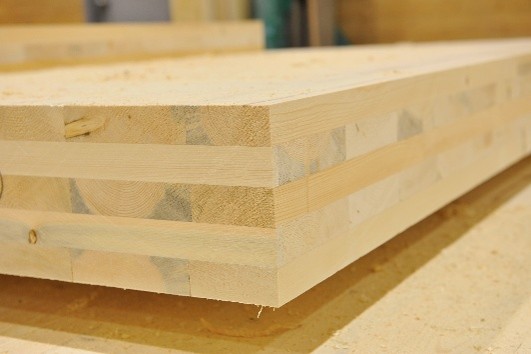
Cross-Laminated Timber (CLT) panels have often been described as plywood on steroids. It is made up of alternating plies of dimension lumber. Like plywood, each ply is oriented perpendicular to its adjacent plies. Common CLT layups are 3 ply (4 1/8”), 5 ply (6 7/8”), and 7 ply (9 5/8”). CLT panels are typically 8 feet or 10 feet wide and up to 60 feet long.
What is a Glulam Timber?
Glued-laminated (glulam) timbers are large, high strength timbers, which are made by stacking up multiple laminations of 2x dimension lumber and gluing them together with a phenol-resorcinol adhesive. It is a clever way of making big timbers out of little trees.
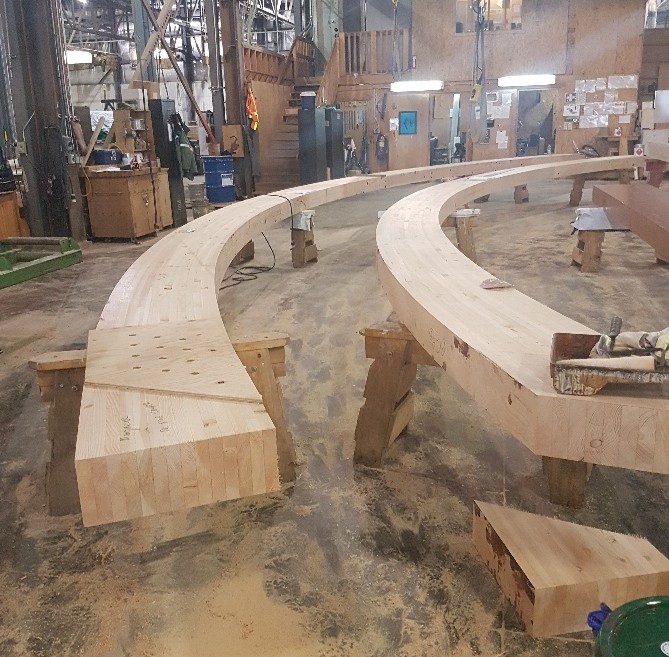
Glulam construction is ideally suited to structures with long spans and curved shapes. If you want a really big timber, all that you have to do is pile on more laminations, you don’t have to go into the forest looking for a giant tree. You can make a glulam timber any length that you want provided that it can fit on a truck for shipping to the site.
Laminating curved glulam timbers is no big deal as long as the radius of curvature is not too tight. Timbers with curved organic shapes open up limitless architectural design opportunities. Sadly, CLT panels do not lend themselves to curved shapes and can only be used on flat surfaces.
Is Mass Timber Sustainable?
From the standpoint of sustainability, it just doesn’t get any better than mass timber. Mass timber structures check all of the boxes. Timber is a natural, bio-based material with low embodied energy, and best of all, it sequesters carbon.
While the construction of steel and concrete buildings introduces copious amounts of carbon into the atmosphere in the form of carbon dioxide, trees remove carbon dioxide from the atmosphere and store it in wood tissue. When trees are harvested to build mass timber buildings, the carbon that had been extracted from the atmosphere is sequestered in the timber for as long as the buildings stand.
Since glulam timbers and CLT panels are manufactured from dimension lumber that has been milled from relatively small trees, mass timber structures promote sustainable forestry. Healthy, sustainably managed forests not only cleanse the air of carbon, but they improve water quality and provide diverse wildlife habitats.
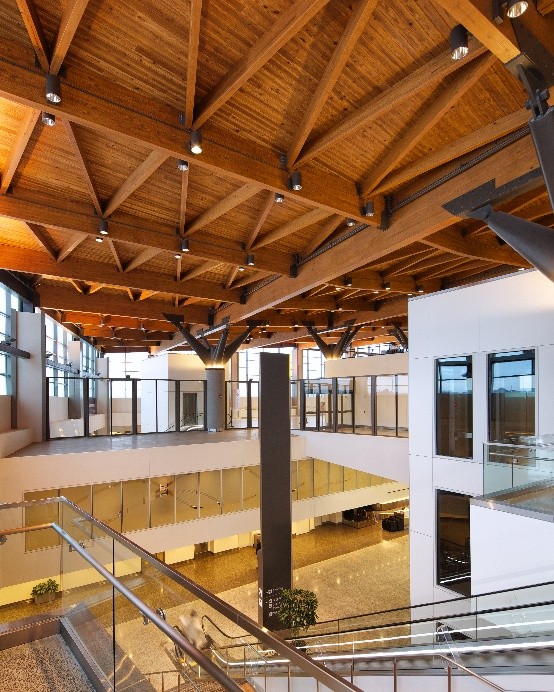
There is something inherently spectacular about the look, feel, and smell of a timber structure. It is almost primal. When people walk into a timber structure, it captures them. The natural instinct is to look up as our eye is drawn to the timbers. The same can rarely be said for steel or concrete structures. Perhaps it is the warmth of the wood or maybe it just reminds us of stately timber buildings that have sheltered and nurtured us for thousands of years.
Timber is a remarkably versatile and sustainable building material. Timber is the material of choice when architectural drama is the objective and a more mundane structure just will not do.
Whether it is a Mass Timber project with glulam timbers and CLT panels, a traditional timber frame with intricate joinery, or the restoration of a historic timber structures that has been down on its luck, we are the go-to guys. Jim DeStefano has been described as the wise old Zen Master of Timber.
View some of our Mass Timber Projects on the Woodworks Innovation Network.
50 Thorpe Street
Fairfield, CT 06824-5725
(203) 254-7131

